Morelia Weather Current conditions as of 23/11/2008 39° FLow: 43° / High: 74°
According to historians, the town of the matlalzincas was established in the valley of Guayangareo during the XIV and XV centuries, in what today is Morelia, a territory that was apparently given to them as a reward for participating in the defense of the purépecha empire during the invasion of the tecos from Jalisco. It is known that when establishing in the valley, meaning “shallow and elongated hillock”, the matlalzincas received the name of “pirindas” or rather “the ones in the middle”, due to the location of the place that they called Patzinyegui.
Like any other native town of the epoch, the evangelizing trace of Spain drew attention in a decisive manner, being in this case the franciscans fray Juan de San Miguel and fray Antonio de Lisboa who would form a catechism school called San Miguel where music and art would be taught, among many other trades. This exchange of cultures would inniciate a stage of notable flourishing for the valley of Patzinyegui, a place that later on would be designated by the viceroy Antonio de Mendoza as the place for the founding of the city, a place that would welcome many Spanish settled in michoacan land. There were 60 colonizing families, 9 monks and some native who in May the 18th of 1541 would make the Foundation Act of Valladolid, an act that would receive the title of city by the king Carlos the I of Spain in 1545. Some years later, in 1553, this recenttly founded town of New Spain would be granted the coat of arms.
Since then, Valladolid has had a notable sociocultural importance, not only for the evolution of the State of Michoacán, but for Mexico.
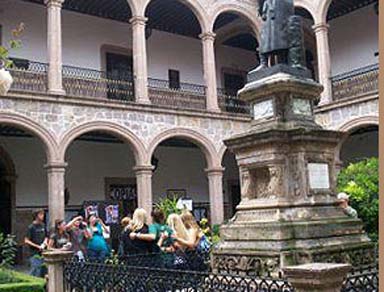
The architecture developed in Michoacán is very distinctive, it has notable diverse buildings where elegance and strictness complement each other with great skill. As example we have the Government Palace, building openned as seminary on January the 23rd of 1770, with a barroque façade which is typical of the city. Its main stairway is held by three irregular formed archs, and it has two large patios where government offices are lodged. When it was a seminary, among its distinguished students, standing out were notable people of great influence in national history, such as the botanist and statistician Juan José Martínez de Lejarza; Mariano Michelana, one of the precursors of the independence movement, as well as two of his heroic executors, José María Morelos y Pavón and Agustín de Iturbide; Melchor Ocampo, main inspirer of the Reform Laws in 1857, among many other well known characters.
About Travel By Mexico : We provide recommendations for hotels, resorts, inns, vacations, travel packages, vacation packages, travel guides, city maps, road maps, videos and much more.
Principal | Destinations | States | Hotels | All Mexico | Maps | Videos | Travel Blog | Contact Us | Sitemap | Advertisement
Travel By Mexico is not responsible for content on external web sites.
Travel By Mexico, SA CV, All rights reserved © 2007